
Post 104 Week Income Replacement Entitlement Assessments/ IE Review & Challenge
HAL Disability Management INC. (HAL) offers the service of evaluating files where, following an motor vehicle accident (MVA) capacity to return to work under the post-104 definition needs to be addressed or is in dispute. At the two-year mark (104 weeks), the definition changes from substantial inability to engage in the essential tasks of their pre-accident employment to “complete inability to engage in any employment given their previous training, education and experience”.
If the client has been getting Income Replacement Benefits (IRB) during the first two years of not working following an MVA, then it is likely that the Insurer will initiate an IE assessment or assessments (depending on the reasons for the IRB being paid in the first place). If that is the case, or the IE assessments have already been done, then HAL offers the service of file review/file management to determine if it is feasible to proceed with rebuttal reply .
If an Insurer post-104 assessment(s) have not been done, then a focused assessment or series of assessments can be conducted to address the issue of post-104 IRB eligibility. HAL Disability has a full roster of assessors to address this issue. In many cases this is best accomplished with a multidisciplinary assessment. Please see the following flow chart for a pictorial representation of this process.
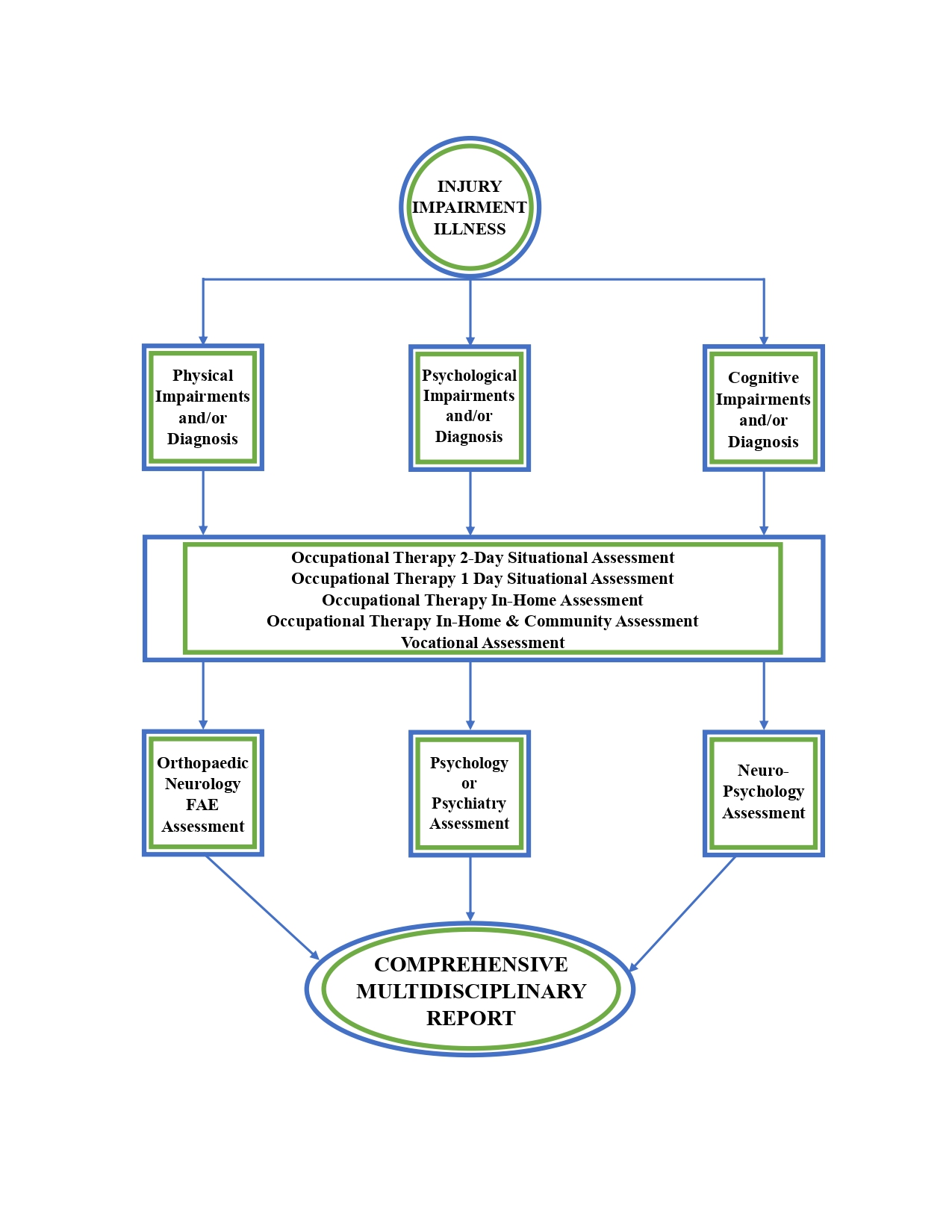
In many cases, where the principle issue is physical impairment, this can be addressed by the relevant medical specialist assessor perhaps aided by input of a Functional Capacity Evaluation.
In many cases, the impairment issues either fall into the realm of mental health or cognitive impairment either in whole, or in combination with physical impairments. Many of the current evaluations of work capability do not really address the complex multidimensionality of work-related impairments.
HAL Disability has a unique and rigorous methodology testing process that looks at other vocationally related factors such as endurance, cognitive capabilities, and emotional impact on employability in the context of each individual client. Where applicable, this can also be added into the assessment group.
This service consists of a multi-day situational work assessment to provide an evidence-based assessment that will evaluate the client’s capacity to sustain attention/concentration, work activity pace, persistence, productivity and stamina. This is completed at a competitive level in consideration of presenting cognitive, emotional, social-interactional (interpersonal/behavioural) and/or physical impairments in the context of work demands across these same domains. These are also addressed in terms of deconditioning, decompensation and deterioration of work performance over two consecutive days which yields strong implications over whether a client can successfully work [meet the work demands] at a competitive rate, on a consistent basis over consecutive days. The systematic observation and analysis of a client’s performance during both standardized work samples and occupation-tailored simulated work activities form the basis of the P104 evaluation’s methodology. Standardized work sample testing applies Method Time Measurement (MTM) industrial performance standards as part of its methodology.
If addressing post-104 in rebuttal reply, the assessment team looks at the following issues when reviewing the IE post-104 assessments.
The lack of comprehensive, evidence-based IE Post 104 or assessment can lead to erroneous denial of Post 104 Week IRB entitlement through undermining the following best practice factors:
- Failure to measure the client’s actual post-condition in occupationally relevant capacities (i.e., occupational aptitudes, academic achievement levels, attained levels of education)
- Inadequate measurement of the client’s physical functioning (i.e., minimal FAE testing)
- Failure to consider/measure the client’s interpersonal functioning and mental/behavioral suitability relative to the demands of the identified occupations
- Failure to consider/measure the client’s current post-accident intellectual/cognitive & language abilities relative to the demands of the identified occupations
- Failure to consider the client’s capacity to psychologically cope with, and adapt to, work-like demands
- Failure to utilize a methodology through which to establish the client’s ability to sustain attention/concentration, work pace and productivity at a competitive capacity on a full-time basis
Multi-day evidence based situational work assessment is conducted: to evaluate the client’s capacity to sustain attention/concentration, work activity pace, persistence, productivity, and stamina at a competitive level in consideration of his/her post-accident cognitive, emotional, social-interactional and/or physical impairments relative to work demands across these same domains. Standardized work samples and simulated work activities form the basis of the evaluations. Typically, a two full-day assessment is used for mild-severe and post-concussion syndrome clients, and a one to two full-day methodology for other injury types where cognitive/emotional issues are clearly influencing the impairment spectrum.
Vocational evaluation can also be offered in order to determine whether there are any potential occupational options given the impairments noted by other assessors and the prior training, education and experience of the client. This is then used to provide a tailored approach to the Post-104 situational work assessment (SWA) where a direct comparison of suggested alternative job demands is made against the client’s presentation and capacity as examined/revealed/evaluated in the SWA.